Best Filing Systems for ADHD Brains
When “Just File It” Feels Impossible
You know that pile of papers on your desk? The one that started as “just a few things to deal with later”? If you have ADHD, that pile probably has a pile on top of it. And maybe another one on the floor nearby. You are not lazy or messy. Your brain just works differently when it comes to organizing things you can’t immediately see or use.
The traditional filing system — alphabetical folders in a drawer — was designed for brains that can think in categories and retrieve things by memory. ADHD brains often don’t work that way. Out of sight really does mean out of mind. The good news is that there are filing systems built around how your brain actually works, not how people think it should work.
Why Traditional Filing Systems Fail ADHD Brains
Most filing advice tells you to sort papers into neat labeled folders and tuck them away. The problem is that ADHD brains rely heavily on visual cues to remember things exist. Once a paper goes into a folder and into a drawer, your brain often forgets it ever existed. This isn’t a character flaw. It’s just how ADHD affects working memory and object permanence.
Another issue is the energy required to maintain a complex system. A filing system with dozens of subcategories might work great on day one. But after a busy week, when papers are piling up again, the thought of sorting them correctly feels overwhelming. Many people with ADHD end up abandoning the system entirely because the upkeep is too demanding. A good system for ADHD brains needs to be simple enough to use on a bad day, not just a good one.
The “Visible Filing” Method
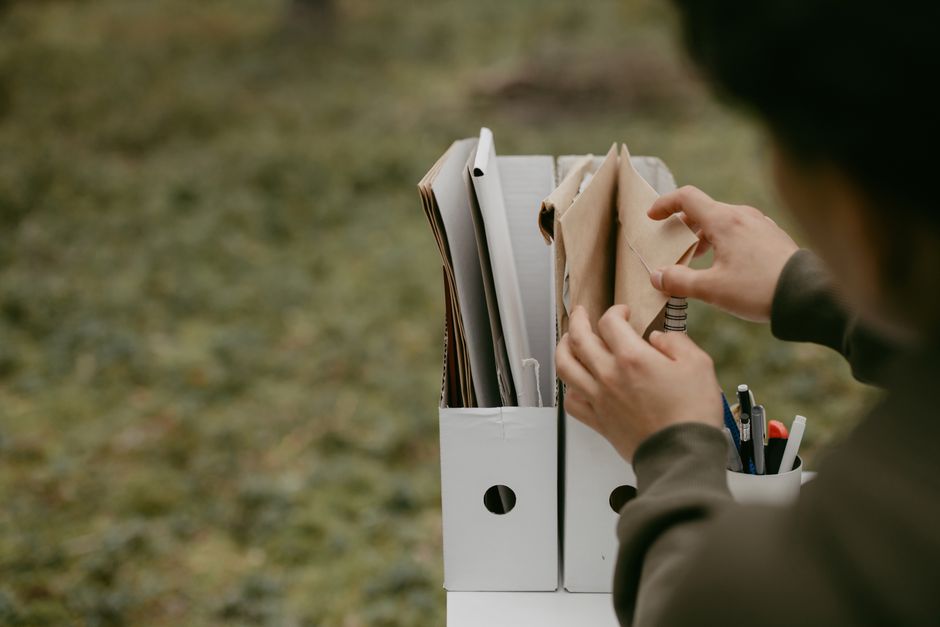
The core idea here is simple: keep things where you can see them. Open shelves beat closed cabinets. Clear bins beat opaque boxes. Vertical file holders on your desk beat anything inside a drawer. When your papers and files are visible, your brain gets the reminder it needs without having to remember on its own.
Try using a small set of color-coded folders in an open desktop file holder. Assign a color to broad categories like bills, school, medical, and work. Don’t overthink the categories. Broad is better than specific. The goal is to be able to see your folders at a glance and grab the right one without hunting. You can even label the folders with big, bold text so reading them takes zero effort.
For papers you are actively dealing with, a simple two-slot tray works well. One slot for “needs action” and one for “waiting or done.” This keeps your most urgent stuff visible without everything blending into one overwhelming pile.
The Three-Pile Paper System
If folders still feel like too much structure, try the three-pile method. This strips filing down to its most basic form. Every piece of paper in your life goes into one of three groups: Action, Reference, and Trash.
Action items are things that need something done soon — a bill to pay, a form to fill out, an appointment to schedule. Reference items are things you don’t need right now but might need later — insurance documents, manuals, tax records. Trash is everything else. The goal is to make a quick decision and move on. You don’t need to perfectly sort anything. You just need to pick one of three buckets.
Keep your Action pile somewhere very visible — on your desk, on the kitchen counter, wherever you spend time. Reference materials can go into a single box or drawer since you won’t need them often. Review your Action pile once a week to clear it out. That’s the whole system. Simple enough to restart after falling off track, which is a key feature for any ADHD-friendly approach.
Going Digital Can Be a Game Changer
Paper is hard to manage partly because it takes up physical space and gets buried. Going digital removes a lot of that friction. Scanning important documents and saving them on your phone or computer means you can search for them instantly rather than digging through stacks. Many phones now have built-in document scanning in the camera app, so you don’t need any special equipment.
For digital files, keep the folder structure shallow. One main folder called “Documents” with maybe five or six subfolders is plenty. Deep folder trees are easy to get lost in. Use simple, searchable file names like “electric bill march 2025” so you can just type a word and find what you need. Search is your best friend when memory is unreliable.
Managing your time alongside your filing system matters too. Tools like the Gaveki app can help you build routines around tasks like weekly paper sorting, so they don’t get forgotten or pushed off indefinitely. Pairing a simple system with a consistent reminder makes it much easier to stay on top of things.
Setting Up Your Space to Support the System
Even the best filing system won’t work if your environment fights against it. Take a few minutes to think about where papers actually land in your home or workspace. That spot — the kitchen counter, the entryway table, your desk — is your natural landing zone. Put your filing supplies right there instead of in another room.
Reduce friction at every step. Keep a recycling bin next to your landing zone so trashing junk mail takes zero steps. Have your folders or trays within arm’s reach. Make the right choice the easy choice. When filing something correctly takes less effort than tossing it on a pile, you’ll actually do it.
It also helps to schedule a regular “paper date” with yourself — even just ten minutes once a week. Put it in your calendar or set a reminder. Gaveki can help you block time for this kind of maintenance task so it actually happens. A small weekly reset prevents the pile from growing back into something overwhelming.
You Don’t Need a Perfect System — You Need One That Works for You
The best filing system is the one you will actually use. It doesn’t have to be Pinterest-worthy or color-coordinated in seventeen shades. It just has to match how your brain thinks and how your life actually runs. Start with the simplest option — maybe just two trays and a recycling bin — and adjust from there.
Give yourself credit for trying. Every time you deal with a piece of paper instead of letting it pile up, that’s a win. Progress matters more than perfection. Your brain isn’t broken. It just needs a system designed for it, not against it.
🧠 Tools That Actually Help ADHD Adults
Free ADHD Focus App
ADHD Productivity Planner
Noise Cancelling Earbuds
Amazon links are affiliate links. We may earn a commission at no extra cost to you.
The ADHD focus app that gets it.
Brain dump, focus shield, routines, and coaching — free to start on iPhone, iPad, and Android.